One clear customer journey
Requests, quotes, orders, payments, documents, and support live in a coherent experience without asking customers for the same information repeatedly.
From the first request to post-sale service
We connect customer portals, accounts, and interface actions to the data and operational processes behind them, so customers can move forward independently while the team stays in control.
Service family · Customer and operations systems
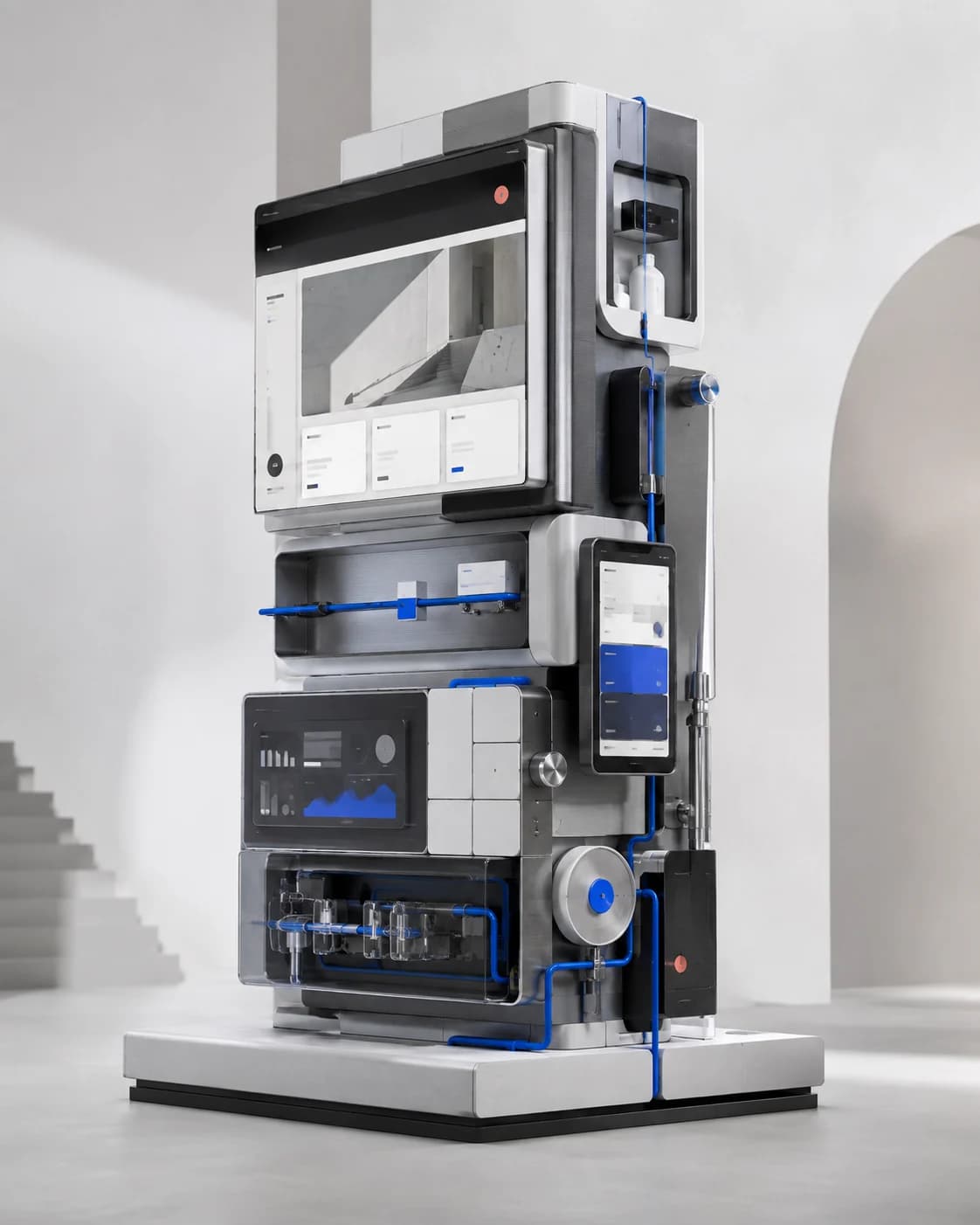
We model customer journeys, roles, approvals, automation, and reporting in one controllable product.
Where we start
A customer does not see your departments and internal tools. They experience one journey: requesting a quote, placing an order, submitting documents, checking a status, paying, and asking for support. When these stages are split across inboxes, forms, and disconnected applications, both the customer and the team inherit the friction.
We build customer portals, configurators, quoting and ordering workflows, web or mobile applications, and self-service areas connected to CRM, ERP, payments, and document systems. Before recommending custom development, we check whether an existing product can cover the need responsibly. Custom is justified when control, integration, or differentiation outweighs the cost of adapting a standard tool.
What the project must achieve
Requests, quotes, orders, payments, documents, and support live in a coherent experience without asking customers for the same information repeatedly.
Customers can check status, update details, download documents, or start an action without waiting for a manual reply at every step.
The portal and internal tools use clearly defined rules and sources of truth, reducing duplication and contradictions between systems.
Validations, approvals, payment failures, and unusual cases receive explicit states for both customers and the people who step in.
Code, data, and infrastructure remain controllable as new customer groups, services, channels, and integrations appear.
01
We map where the customer enters the system, the decisions they need to make, the information required, and what they expect after each action. We follow the same journey inside the company: who validates it, which system owns the data, and where delays or exceptions emerge.
The first deliverable is not a screen inventory. It is one complete journey that can be understood, tested, and measured. This separates what must be built from steps that can be removed, simplified, or covered by an existing product.
02
A simple customer experience can require serious rules behind it: eligibility, contract pricing, availability, approvals, payments, notifications, and reconciliation. We design these together so the interface never promises something operations cannot deliver.
We separate responsibilities such as accounts, orders, documents, billing, and support without introducing distributed complexity before it is needed. Every module begins with a result that can be verified by both the customer and the company.
03
Customers should know what happened, what comes next, and how to correct a problem. We design confirmations, history, permissions, and recovery paths in proportion to the risk of each action—not only the ideal demonstration flow.
We can work in repositories, cloud accounts, and environments owned by the client. Decisions are documented, monitoring is prepared, and transfer remains possible, so the customer relationship does not depend on an inaccessible technical black box.
How we work
We follow a customer request from first contact through delivery, payment, and support, including the real exceptions.
We choose one complete flow, test it with the people involved, and define the outcome that justifies development.
We build the interface, rules, integrations, and error states as one verifiable journey.
We observe where customers succeed, abandon, or need help, then prioritise the next version using real product evidence.
Frequently asked questions
Customer portals, configurators, quoting, B2B or B2C ordering, bookings, accounts and subscriptions, payments, documents, status tracking, support, and web or mobile applications connected to company systems.
A website explains and generates interest. A customer-facing system lets a user create an account, submit data, complete actions, and follow outcomes. They can be part of the same experience, but their data, security, and operational requirements are different.
Yes, when the providers expose suitable APIs, webhooks, exports, or other stable interfaces. We verify limits, the official source of each data point, and failure behaviour before defining the automation.
Yes. We prefer a complete, bounded journey—such as request, quote, and acceptance—that provides value on its own and creates a sound foundation for later modules.
We define the commercial outcome, the first complete journey, and acceptance criteria. New functions enter the plan only after their effect on experience, data, delivery time, and operating cost is visible.
Ownership, licences, and transfer are stated explicitly in the contract. We can work in client-owned accounts and repositories and prepare data exports, documentation, and operation without hidden dependencies.
Describe one concrete journey, from the first request to the result. We will turn it into a product core that can be tested, estimated, and delivered in stages.
Describe the customer journey