A testable product promise
The initial release serves a defined customer and recurring job, with a result that can be observed rather than a broad list of capabilities.
The customer product and the operating system behind it
We turn a product hypothesis into a complete first journey and build the account, billing, administration, data, and delivery foundations needed to operate it.
Service family · Digital products
Design, logic, and testing evolve together from the first critical journey to the product used every day.
Where we start
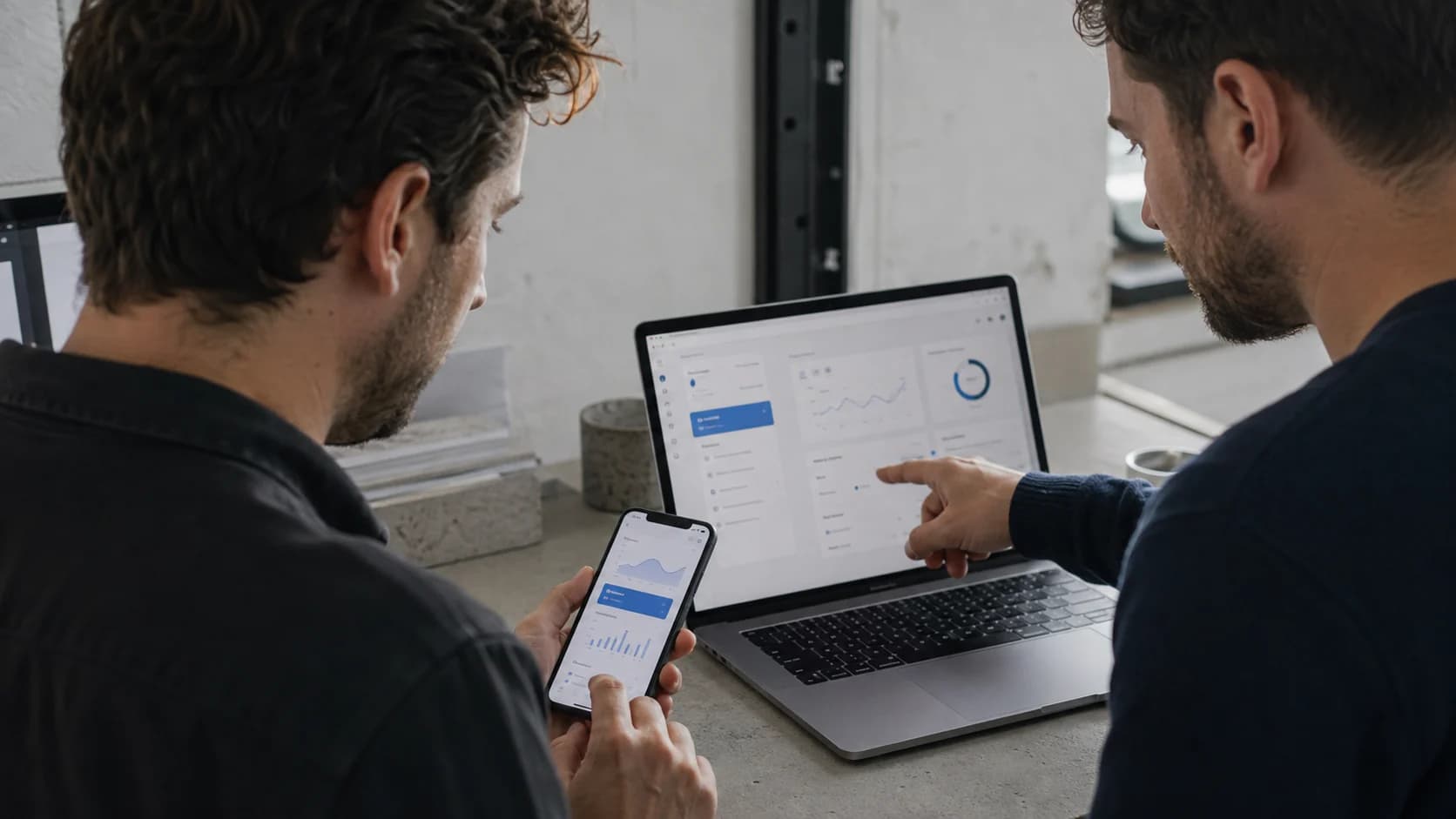
A SaaS product is not complete when its main feature works. Customers also need to evaluate, join, invite colleagues, understand limits, manage plans, receive help, and trust their data. The team behind the product needs administration, support context, billing states, measurement, and safe releases.
We design both sides together. The first version is deliberately bounded around a customer group and a recurring job, but it includes the operational path required to sell and support real use. Architecture evolves as evidence appears rather than anticipating every possible market in the first release.
What the project must achieve
The initial release serves a defined customer and recurring job, with a result that can be observed rather than a broad list of capabilities.
Organisations, users, invitations, access, and data separation reflect the real product model from the beginning.
Plans, trials, entitlements, invoices, failed payments, upgrades, and cancellations are translated into explicit product behaviour.
The operating team can understand account state, investigate problems, and take authorised actions without direct database improvisation.
Activation, successful use, friction, reliability, and support signals are available to inform product priorities.
01
We define the target account, the recurring problem, the moment value becomes visible, and what the team must do to deliver that value. This creates an MVP boundary that is small enough to learn from and complete enough for honest customer use.
Discovery also tests whether custom SaaS is justified. Existing products, service-assisted delivery, or a narrower internal tool may validate the need faster. Building becomes the recommendation only when the product advantage and ownership case are clear.
02
Tenancy, roles, entitlements, subscription state, usage, and data lifecycle affect both user experience and backend architecture. We define them explicitly instead of letting billing, access, and support develop as disconnected patches.
External services are integrated behind clear responsibilities. Payment, email, identity, files, and analytics include limits and failure paths, while core product logic stays portable enough for future decisions.
03
We prepare environments, migrations, monitoring, backups, security controls, and rollback according to the product risk. The release process should make small improvements safer rather than turning every deployment into an event.
Product analytics are connected to specific questions about activation and use. Combined with sales, support, and reliability evidence, they help decide what to improve, remove, automate, or postpone.
How we work
We define the first customer, recurring job, alternative solutions, evidence, and commercial assumption worth testing.
We prototype the path from evaluation and signup to the first meaningful result, including the operational work behind it.
We connect interface, account model, core logic, administration, billing states, data, and monitoring into a complete release.
We use customer behaviour, support, sales, and reliability evidence to choose the next investment.
Frequently asked questions
Yes. We define the MVP around one customer group and a complete recurring job. It normally includes only the product, account, administration, billing, and support capabilities required to sell and operate that journey responsibly.
Not always. Manual invoicing or an assisted pilot can be appropriate while pricing and value are uncertain. If self-service billing is required, product access must reflect trials, payment failures, plan changes, cancellations, and refunds clearly.
We model organisations, membership, roles, invitations, ownership, and data separation explicitly. The exact approach depends on collaboration rules, compliance needs, and whether users can belong to more than one account.
Yes. We map which system owns each piece of data, how identity and permissions cross the boundary, what volumes and limits apply, and how both users and operators recover when an external service fails.
We keep boundaries and data responsibilities clear while choosing the simplest deployable architecture that supports the current product and team. More distributed infrastructure is introduced only when evidence justifies its operational cost.
Yes. We can support product discovery, design, engineering, infrastructure, monitoring, maintenance, and staged expansion using evidence from real customers and operations.
Describe the customer, current alternative, and moment they receive value. We will help define a sellable and supportable first scope.
Discuss your SaaS platform