A proposition buyers can understand
Services, proof, decisions, and calls to action are organised around real buyer questions instead of internal company structure.
Strategy, content, design, and development in one team
We create websites that make a complex offer easier to understand, give buyers the evidence they need, and turn qualified interest into a clear next step.
Service family · Public presence
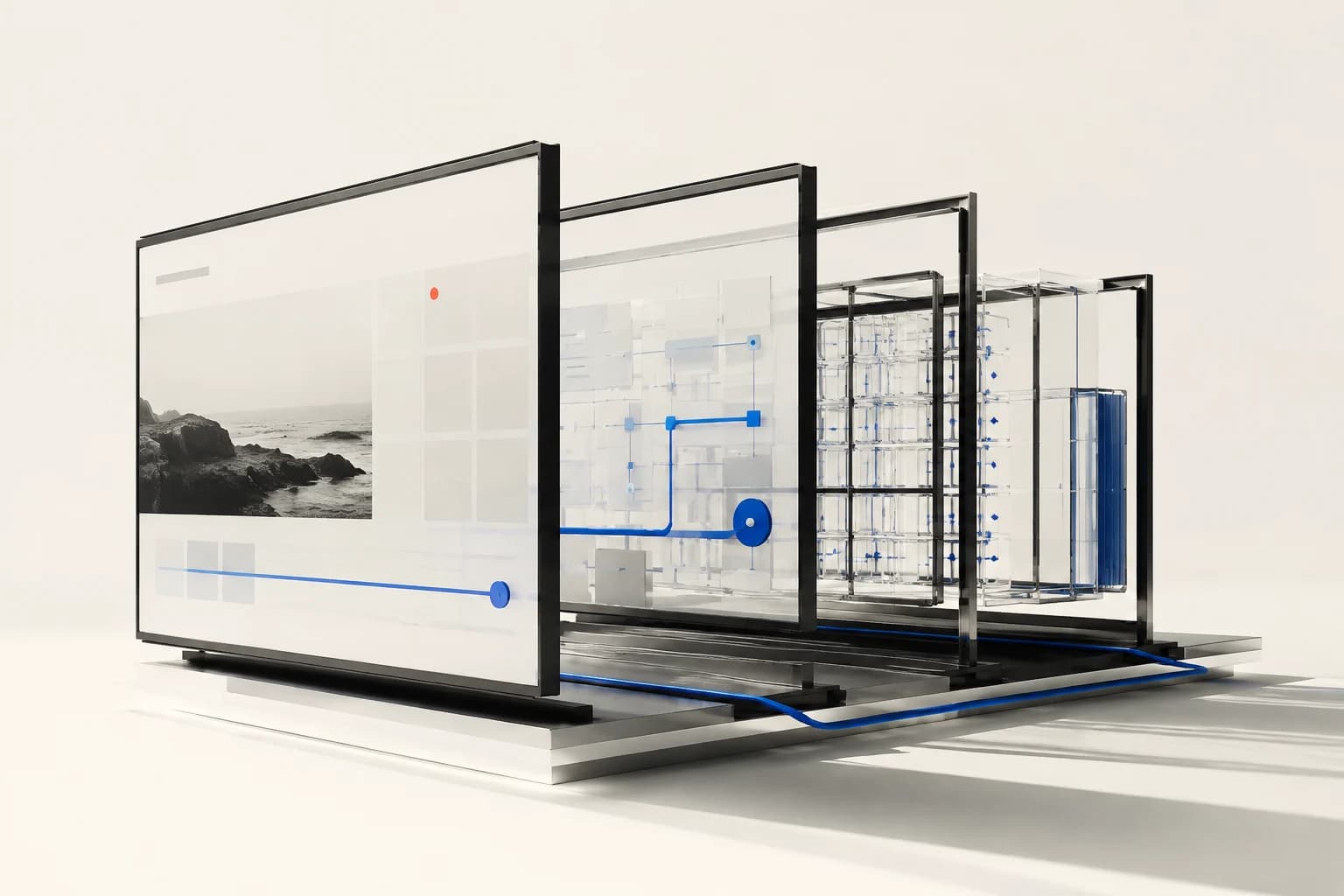
We build the journey from raw information to a fast, clear, and maintainable public experience.
Where we start
A company website has to do more than present a brand. It must help the right visitor recognise their problem, understand the offer, judge credibility, and know what to do next. We begin with audiences, buying questions, existing content, and commercial goals before choosing page layouts or technology.
We design and build corporate, service, multilingual, and editorial websites as maintainable systems. Content structure, responsive behaviour, accessibility, performance, search visibility, analytics, and ownership are treated as parts of the same release—not separate additions near launch.
What the project must achieve
Services, proof, decisions, and calls to action are organised around real buyer questions instead of internal company structure.
Each important page has a job and carries the visitor toward a relevant contact, brief, booking, or qualification step.
Semantic structure, crawlable links, metadata, canonicals, language alternates, sitemaps, and migration rules are planned with the content.
Typography, media, interaction, keyboard use, reduced motion, and loading behaviour are tested across relevant mobile and desktop sizes.
Reusable components and editorial rules make routine updates possible without slowly dismantling the design.
01
We review the offer, audiences, sales questions, proof, and current search footprint. From that evidence we define the page architecture, the role of each page, and the information a visitor needs before making contact.
If an existing site already receives traffic, the rebuild is treated as a migration. Valuable URLs are preserved where possible, changed addresses receive deliberate redirects, and content is not removed simply because it does not fit the first visual draft.
02
The design direction grows from the company identity and the material the website must carry. We define typography, grid, colour, media, components, and interaction states as one system, then test it with realistic pages and copy.
Motion is used when it clarifies hierarchy or transition. Accessibility, touch targets, contrast, keyboard navigation, and reduced-motion preferences are resolved during design and implementation, not delegated to a final checklist.
03
We implement the responsive site, connect approved forms and services, prepare structured metadata, and test the critical journeys. A CMS is included when frequent internal publishing justifies it; a simpler setup may be better for a stable website.
Before release we verify routes, forms, tracking consent, search directives, redirects, analytics, and rollback. The team receives a clear way to operate the site and a foundation for future pages without hidden platform lock-in.
How we work
We define audiences, commercial goals, available evidence, content responsibility, and the result the website must support.
We validate the sitemap, priority pages, messages, and user paths before visual detail makes structural problems expensive.
Design, content, and implementation evolve together in real pages, with responsive and accessibility decisions visible early.
We migrate carefully, verify production, measure useful actions, and use the first evidence to prioritise improvements.
Frequently asked questions
Corporate and service websites, multilingual sites, editorial platforms, campaign destinations, recruitment portals, and public experiences that can connect to forms, CRM, commerce, or operational systems.
Yes. We can structure the proposition and write or rewrite the website with the people who know the company. We do not invent credentials, results, clients, or claims that cannot be supported.
Yes when routine editing is a real requirement. We design reusable fields and components that protect the experience while letting the team publish. For rarely changed sites, a simpler setup can reduce cost and maintenance.
We can reduce migration risk by auditing current URLs and content, preserving valuable paths, mapping redirects, keeping canonicals and language alternates coherent, and monitoring the release. No responsible team can promise that rankings never fluctuate.
Yes. The choice depends on publishing needs, integrations, security, performance, team skills, and ownership. We recommend the least complex approach that can support the required experience responsibly.
The main variables are page and component types, content work, languages, CMS needs, integrations, migration risk, visual exploration, and approval process. We define these before presenting a scoped estimate.
Share the offer, audience, current site, and the next action that matters. We will help turn them into a clear first scope.
Discuss your website